How 19th-century society metabolized the most terrifying technology it had ever encountered
On September 15, 1830, the fastest machine on Earth killed a man in front of the Prime Minister.
The occasion was supposed to be a triumph. The Liverpool and Manchester Railway -- the world's first intercity passenger line -- was making its inaugural run before the Duke of Wellington, eight cabinet ministers, and thousands of spectators. At Parkside, roughly halfway along the 35-mile route, the locomotive procession stopped to take on water. The railway company had warned everyone to stay aboard. Around fifty dignitaries ignored the instruction and stepped down onto the trackbed, among them William Huskisson, Member of Parliament for Liverpool, former Secretary of State for War, and one of the most prominent political figures in England.
Huskisson approached Wellington's carriage. The two men had been locked in a bitter political estrangement, and Huskisson saw the stop as a chance to broker reconciliation. He reached Wellington's window. They shook hands. Then someone shouted.
The Rocket was bearing down on the adjacent track.
Huskisson panicked. He grabbed the open door of Wellington's carriage, but instead of pulling himself clear, the door swung outward -- wider than the gap between the two trains. The locomotive struck it and dragged him under its wheels, mangling his left leg beyond repair. The crowd watched in horror.
What happened next contained the entire paradox of the railway age compressed into a single evening. The same technology that had just crushed Huskisson's body now carried it to the nearest town at a speed no wounded person had ever traveled before -- roughly 36 miles per hour, fast enough to outrun any horse-drawn ambulance in existence. He was rushed to Eccles, where he dictated his will and died at nine o'clock that night.
His funeral, nine days later, became a spectacle that dwarfed the opening ceremony. His widow had wanted a quiet burial. She was overruled by the sheer weight of public grief. Liverpool issued colour-coded tickets to manage the mourning crowds. Spectators packed the rooftops. Nearly every business in the city closed its doors. And the newspapers -- The Times, the Manchester Courier, The Examiner -- ran detailed accounts that, for the first time, made people around the world aware that cheap, rapid, long-distance transport was now possible. The first widely reported railway casualty became, inadvertently, the most effective advertisement the railway industry ever received.
But death was not the only story those tracks told that autumn.
"You can't imagine how strange it seemed to be journeying on thus, without any visible cause of progress other than the magical machine, with its flying white breath and rhythmical, unvarying pace."
-- Fanny Kemble, August 1830
Three weeks before Huskisson died at Parkside, the actress Fanny Kemble had ridden the same line on a test run with the railway's engineer, George Stephenson. She described the locomotive as "this snorting little animal, which I felt rather inclined to pat" -- one of her "tame dragons." Standing up with her bonnet off to feel the wind on her face, she declared that "no fairy tale was ever half so wonderful" as what she saw. She reported a "perfect sense of security, and not the slightest fear."
Terror and wonder, separated by twenty days on the same stretch of rail. That duality -- technology as simultaneously miraculous and lethal, as liberation and threat -- defined not just the opening of the Liverpool and Manchester but the half-century of upheaval that followed. Doctors would try to diagnose the railway's effects on the body. Priests would denounce its violation of the Sabbath. Poets would mourn the landscapes it devoured. Workers would die by the thousands building it. Women would fight for the right to ride it alone. And through all of this, the machine would keep moving, reshaping every institution it touched.
The popular version of the railway's reception runs something like this: ignorant Victorians feared trains would make them go insane; doctors warned that speeds above twenty miles per hour would cause a condition called delirium furiosum; eventually people realized the technology was safe and got over it. The story flatters the present by making the past look foolish.
Almost none of it is true. The most famous medical warning about railways -- the one you have probably heard -- appears to be a fabrication. And the real fears that replaced it in the historical record were not silly at all. They were the fears of a civilization confronting invisible injuries, contested diagnoses, and a medical profession whose conclusions reliably correlated with who was signing the checks.
The real story is harder, stranger, and more revealing. It is the story of how an entire civilization -- its doctors, its priests, its poets, its workers, its aristocrats, its women fighting for the right to travel alone -- metabolized a technology that rearranged everything it touched: the human body, the clock, the landscape, the class system, the empire. The fears were not silly. The resistance was not futile. And the process by which terror became routine holds a mirror up to every technological disruption that followed.
This is that story.
The most famous medical warning about railways never happened. The story goes like this: in 1835, the Bavarian Royal College of Doctors -- the Konigliches Bayerisches Obermedizinalkollegium -- issued an official proclamation that passengers traveling by train risked developing delirium furiosum, a violent madness triggered by speeds exceeding twenty miles per hour. The tale appears in popular histories, educational materials, and even academic citations as established fact. It is a fabrication.
The German researcher Michael Schmalenstroer traced the claim to its earliest verifiable source: the Prussian historian Heinrich von Treitschke, writing in 1879 -- more than four decades after the supposed warning. The institution named in the story did not exist in Bavaria in 1835. Researchers who combed the Bavarian state archives and the Nuremberg Transport Archive found nothing. The Nuremberg Archive concluded the document never existed. And the claim collapses under basic logic: horses routinely galloped at thirty kilometers per hour, sailing ships moved considerably faster in strong winds. The idea that physicians trained in human physiology would have panicked over velocities their patients had experienced on horseback for centuries strains credibility past its breaking point.
Why does a ghost document matter? Because delirium furiosum functions as a straw man. By making 19th-century medicine look absurd, the myth obscures what doctors actually confronted -- patients presenting real, debilitating symptoms after railway accidents, symptoms that no existing medical framework could adequately explain. The genuine medical story is harder to dismiss, and far more consequential. It produced the conceptual vocabulary that would eventually become modern trauma theory, psychosomatic medicine, and PTSD.
The real collision between railways and medicine began not in a clinic but in a courtroom. The Campbell Act of 1846 established that railway companies bore legal liability for passenger safety, and its 1864 amendment strengthened those protections. British courts suddenly needed medical experts to answer a question for which medicine had no ready framework: could a person suffer genuine, debilitating injury from a railway accident when no bones were broken and no wound was visible?
John Eric Erichsen, a prominent surgeon at University College Hospital London, supplied the first systematic answer. His 1866 book On Railway and Other Injuries of the Nervous System proposed that the violent jolts of railway collisions caused "molecular derangements" in the spinal cord -- damage at a level below what anatomy could detect. His analogy was mechanical: a watchmaker had told him that when a watch's glass was broken, the works were rarely damaged, but when the glass survived intact, "the jar of the fall will usually be found to have stopped the movement." The body's external intactness proved nothing about the mechanism inside.
The rebuttal came from Herbert William Page, a surgeon who trained under Jonathan Hutchinson and Hughlings Jackson before becoming consulting surgeon to the London and North-West Railway. Page's 1883 book argued Erichsen had inverted cause and effect. Where Erichsen saw invisible physical damage, Page saw fear itself producing paralysis, numbness, fatigue, and cognitive collapse -- "largely psychological disorder of the brain and central nervous system caused by fear or fright alone."
The physician's paycheck reliably predicted his diagnosis. Erichsen, the independent academic, testified for plaintiffs and found organic spinal damage. Page, employed by a railway company, testified for defendants and found psychological causation. Victorian observers noticed this pattern, and it damaged public trust in medical expertise.
Railway companies lost roughly 70 percent of litigation cases, creating enormous financial incentive to undermine the somatic theory. The Lancet and the British Medical Journal published opposing positions on railway injuries, transforming what could have been a narrow clinical dispute into a public spectacle of medical disagreement. When Wilhelm Rontgen's X-rays arrived in 1895 and revealed no structural damage in patients exhibiting severe symptoms, Erichsen's lesion hypothesis was effectively finished. But the deeper paradox survived: Page's psychological theory -- closer to our modern understanding -- had been advanced by the side with the least sympathetic motives. The railway companies promoted the idea that injuries were "merely" psychological because doing so reduced their legal exposure. The side with the right science had the wrong motives. The side with the right motives had the wrong science. Truth and justice were not aligned in the railway spine debate, and that misalignment still haunts how courts treat compensation claims for invisible injuries.
The railway body was never a neutral body. Claims circulated that vibrations and speed could damage the female reproductive system -- including the poorly sourced but widely repeated assertion that high-speed travel might displace a woman's uterus. These claims functioned less as genuine medical hypotheses than as rhetorical weapons against female mobility. The Quarterly Review observed in 1844 that railways had achieved "the emancipation of the fair sex, and particularly of the middle and higher classes, from the prohibition from travelling at all." That was not metaphor. Railways physically enabled independent female movement in ways horse-drawn transport never had, and the medicalization of that movement was, at least partly, backlash.
Ladies-only compartments were introduced as necessary protections for vulnerable female bodies. Women largely rejected them. When the Board of Trade surveyed usage in 1888, the Great Western Railway reported that of 1,060 available ladies-only seats, only 248 were occupied by women. Meanwhile, 5,141 women chose to travel in smoking compartments -- nominally masculine spaces, certainly not designed for female comfort -- rather than accept segregation. The numbers are stark: women preferred tobacco smoke to paternalism by a ratio of more than twenty to one.
Jean-Martin Charcot, the "Napoleon of Neuroses" at the Salpetriere, complicated the gender picture from the opposite direction. In the 1880s, he extended the diagnosis of hysteria -- a condition etymologically rooted in the Greek hystera, meaning uterus -- to male railway workers and soldiers. Railway engineers, "models of masculinity," could develop hysteria through traumatic shock. By medicalizing men's post-accident symptoms under the same label long reserved for women's supposed weakness, Charcot simultaneously legitimized male psychological suffering and exposed the absurdity of a diagnostic framework anchored to female anatomy. If a railway engineer pulling bodies from a wreck could be hysterical, the entire conceptual architecture linking that word to the uterus was undermined.
In 1879, the German physician Rigler documented an uncomfortable discovery: after Prussia established third-party insurance for railway injuries in 1871, the rate of post-traumatic symptoms climbed. Patients with access to compensation developed more symptoms, and those symptoms persisted longer, than patients without it. The concept of compensation neurosis was born -- the idea that financial incentive, consciously or not, amplified suffering. Hermann Oppenheim, a Berlin neurologist, pushed back. His 1892 study of 42 cases of traumatic neurosis following railway accidents argued that a "strong noxious stimulus" could impair the central nervous system independent of any desire for payment. The fight between Oppenheim and his opponents in Berlin lasted from 1889 to 1916. The question they wrestled -- whether psychological trauma can be legitimate when money is involved -- remains unresolved in corners of insurance medicine today.
Charles Dickens lived this question without the benefit of medical language. After surviving the Staplehurst crash on June 9, 1865 -- his carriage hanging off a broken viaduct while he climbed into the ravine to tend the dying with brandy carried in his top hat -- he developed what he called "the shake." Sudden episodes of weakness and terror. A persistent illusion that the carriage tilted to the left. Vague rushes of panic in hansom cabs, "perfectly unreasonable but unsurmountable." His children reported that during these episodes he appeared to enter a trance, unaware of other people. He gripped the seat with both hands. Sometimes he had to exit the train early and walk. He died exactly five years after the crash, on June 9, 1870.
Dickens had no compensation claim, no financial motive, no reason to perform his suffering. He was simply broken in a way that no Victorian physician could see on an X-ray or locate with a scalpel. And he was far from alone. Across Britain and America, the railway surgeons were accumulating hundreds of patients just like him -- and they were learning. The National Association of Railway Surgeons, founded in 1888, grew to nearly 1,000 members by 1891. By World War I, railway companies employed some 14,000 doctors -- roughly ten percent of the entire American medical profession. These physicians, confronting cases daily that drugs and surgery could not resolve, arrived at what the literature describes as "the first American medical specialty to achieve a consensus regarding the therapeutic value of what would soon be known throughout the world as psychotherapy." They prescribed rest, isolation, and suggestive therapeutics -- listening to patients and offering positive suggestions. Not Freudian theory. Practical necessity. The railway yard, not the Viennese consulting room, may be the true birthplace of systematic psychotherapy.
When World War I produced hundreds of thousands of soldiers with shell shock -- the same constellation of paralysis, numbness, nightmares, and cognitive collapse that railway passengers had exhibited fifty years earlier -- military physicians drew directly on the railway spine literature. The debate replayed: physical blast damage versus psychological terror, genuine suffering versus malingering for pensions. The body under siege by the railway had, without anyone quite intending it, built the conceptual scaffolding for understanding the body under siege by war.
The railway did not just move passengers through space. It forced an entire civilization to confront what happens to the human mind when the human body is subjected to forces it never evolved to withstand -- and the answers to that question reshaped not just medicine but the very concept of what constitutes an injury. Those answers, in turn, depended on questions the railway raised about something even more fundamental than the body: what happens to space itself when a journey that once took days shrinks to hours, and what happens to time when every town's clock must answer to a single, distant authority.
Heinrich Heine, 1843"Space is killed by the railways, and we are left with time alone."
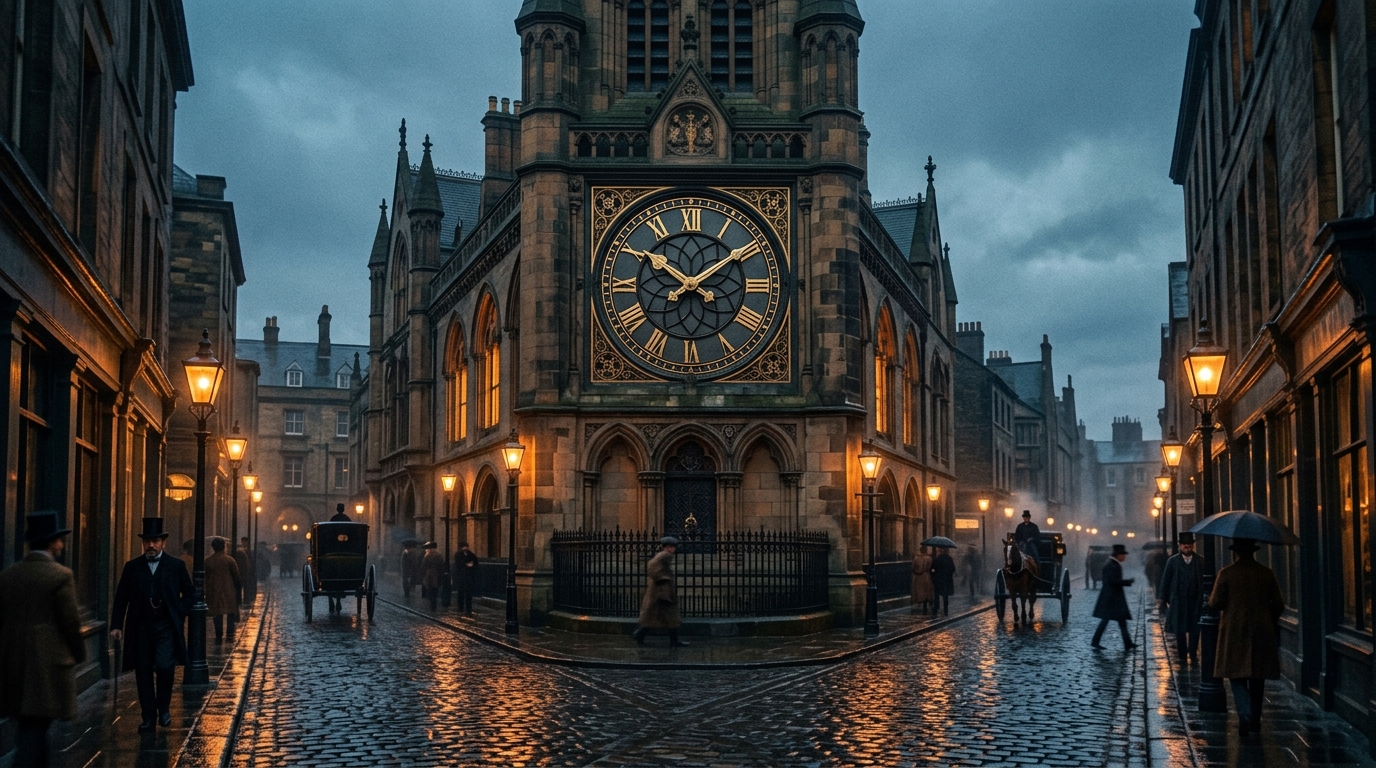
Until 1852, Christ Church College, Oxford ran on a different clock than the railway station half a mile away. When Britain adopted Greenwich Mean Time that year, the college refused. The great clock on Tom Tower was fitted with two minute hands -- one showing local Oxford time, five minutes and two seconds behind London, and one showing railway time. Every evening the Great Tom bell rang its 101 strokes at 9:05 PM -- which was, by Oxford reckoning, precisely 9:00. This was not charming eccentricity. It was institutional defiance: a medieval college insisting that the sun's position over its quadrangle mattered more than a railway timetable printed in Paddington.
Bristol's Corn Exchange mounted its own act of resistance -- a clock with a black hand for local solar time and a red hand for railway time, the two separated by a ten-minute gap that made the politics of timekeeping visible to anyone glancing up from the trading floor. These dual-handed clocks were material artifacts of a philosophical crisis. To standardize time was to sever the ancient relationship between the position of the sun and the number on the dial -- to make time abstract, portable, and industrial rather than local, embodied, and natural. The railway did not invent clock time. But it made clock time mandatory in a way no previous institution had managed.
In America, the resistance was louder and more explicitly political. When railroad delegates at the General Time Convention adopted four standard time zones on October 11, 1883, the Indianapolis Daily Sentinel erupted. Citizens would now have to "eat, sleep, work... and marry by railroad time." Ministers would "be required to preach by railroad time -- banks will open and close by railroad time -- in fact, the Railroad Convention has taken charge of the time business." Another editorialist reached for cosmic satire: "The sun will be requested to rise and set by railroad time. The planets must, in the future, make their circuits by such timetables as railroad magnates arrange."
This was not Luddism. It was a precise identification of what was being transferred: temporal authority, from nature and local community to an industrial cartel. And the editorialists were right about the power grab, if not about its reversibility. Congress did not officially ratify railroad time zones until the Standard Time Act of 1918 -- thirty-five years after the railroads imposed them. For over three decades, the most fundamental parameter of American daily life had no legal basis, enforced entirely by the practical necessity of catching a train.
Time standardization was the most concrete manifestation of a deeper shift -- what one scholar would call the railway's assault on the very categories through which humans understood space and distance. Wolfgang Schivelbusch's The Railway Journey (1977) gave this transformation its most enduring language. His two core concepts -- the "annihilation of space and time" and "panoramic perception" -- have shaped nearly all subsequent scholarship on how railways restructured consciousness. The annihilation thesis holds that railways destroyed the traditional relationship between distance and duration, collapsing journeys of days into hours and rendering the intervening landscape meaningless. Panoramic perception describes the new mode of seeing that replaced the old: where a stagecoach passenger engaged deeply with hedgerows and villages passing at walking speed, the railway passenger experienced a flattened, cinematic blur -- what Schivelbusch called "evanescent reality." Reading became the railway's signature activity not because passengers were bored, he argued, but because a book provided an "imaginary surrogate landscape" to replace the real one that had become perceptually inaccessible at thirty miles per hour.
The framework is elegant. It is also, according to a significant critique published in The Historical Journal by Cambridge University Press, a "bad historical concept." The authors argue that the annihilation metaphor originated as satirical hyperbole in the 1830s, "lost its original comical power," and "became part of the official jargon of modernization" by decade's end. More fundamentally, they contend that railways did not annihilate space -- they created new spaces. Railway stations were novel social environments without precedent. The compartment was an entirely new form of intimate public space. The corridor became a liminal zone between departure and arrival. Schivelbusch's reliance on high-culture literary sources -- Heine, Hugo, Ruskin, writers professionally disposed to mourn the loss of contemplative experience -- produced a sample bias that overstates alienation and systematically filters out pleasure.
The primary sources bear out the critique. When Fanny Kemble rode with George Stephenson on a test run of the Liverpool and Manchester Railway in August 1830, she did not describe perceptual impoverishment. She described standing up with her bonnet off to "drink the air before me." The locomotive was "this snorting little animal, which I felt rather inclined to pat." The landscape at speed was not evanescent but magical: "no fairy tale was ever half so wonderful as what I saw." The 1830 Charleston Courier celebrated that passengers "flew on the wings of the wind... annihilating time and space" -- using the very phrase Schivelbusch would later treat as an expression of loss, but deploying it as pure exhilaration. The tension between Schivelbusch's framework and the lived evidence remains genuinely unresolved: did the literary intellectuals perceive something the general public simply had not yet learned to mourn, or did Schivelbusch mistake one class's aesthetic anxiety for a universal transformation of consciousness?
The railway's most unexpected perceptual invention was not the blur outside the window but the unbearable intimacy inside the carriage. The enclosed compartment, derived from the stagecoach template, created a social situation without historical precedent: strangers locked together in a small space, hurtling through the countryside, unable to exit or summon help until the next station. Georg Simmel identified the novelty in his 1907 sociology of the senses -- before railways, he observed, "people were quite unable to look at each other for minutes or hours at a time, or to be forced to do so, without talking to each other." The compartment invented a new problem: the enforced, sustained gaze between people who had no relationship and no shared purpose beyond arriving somewhere.
Simmel's observation became the seed of a sociological lineage. Erving Goffman developed it into his concept of "civil inattention" -- the complex social choreography by which strangers in shared spaces carefully avoid acknowledging each other's existence while remaining exquisitely aware of their presence. The modern ritual of staring at a phone on a subway car is the direct descendant of the Victorian ritual of burying oneself in a W.H. Smith railway novel. The technology changes; the social problem the compartment created -- what do you do with your eyes when you are trapped with strangers? -- has not been solved so much as managed with ever-updating props.
The anxiety was not merely social. On July 9, 1864, Franz Muller, a 24-year-old German tailor, beat Thomas Briggs, a 69-year-old City banker, and threw him from a North London Railway compartment. No one knew a murder had occurred until the next passengers entered the blood-soaked carriage at the following station -- because the compartment had no corridor and no way to communicate with the crew. The case became a transatlantic sensation: Muller fled to New York by ship, was pursued by Scotland Yard detectives who arrived on a faster vessel, and was hanged before a crowd of 50,000. The legislative aftermath -- the Regulation of Railways Act 1868, mandating communication cords on long-distance trains -- transformed the physical architecture of rail travel. Railway companies cut peepholes into compartment partitions, ghoulishly nicknamed "Muller's lights." Eventually, the British system adopted the corridor carriage, abandoning the sealed compartment that had produced the crisis. One design decision, inherited unthinkingly from the stagecoach, had rippled through law, architecture, sociology, and everyday behavior.
The first-person record of railway experience resists any single narrative. Kemble's delight. Heine's metaphysical violence. The Charleston Courier's giddy velocity. And then there is Charles Dickens.
On June 9, 1865, Dickens's train from Folkestone hit a gap in a viaduct under repair -- the foreman had consulted the wrong timetable. All seven first-class carriages plunged off the bridge except the one carrying Dickens, Ellen Ternan, and her mother, which hung suspended by its coupling over the ravine. Dickens climbed down to the wreckage, spent hours tending to the injured and dying with brandy and water carried in his top hat, then returned to the swaying carriage to retrieve his manuscript of Our Mutual Friend.
What followed was what modern clinicians would recognize as post-traumatic stress disorder. Dickens developed "the shake" -- sudden episodes of weakness, faintness, and nervous terror. For the rest of his life, every train journey produced "a persistent illusion that the carriage was down on the left side." A year after the crash, he still suffered "sudden vague rushes of terror, even when riding in a hansom cab, which are perfectly unreasonable but unsurmountable." His children reported that during these episodes he appeared to enter a trance, gripping the seat with both hands, unaware of anyone else in the carriage. He died exactly five years after the crash -- June 9, 1870 -- a coincidence his contemporaries found deeply unsettling.
Kemble's wonder and Dickens's trauma are not contradictions. They are the two poles of what it meant to encounter a technology that reorganized the most basic categories of human experience -- distance, duration, proximity, safety -- faster than any society had vocabulary to describe. The railway did not simply annihilate space and time. It forced an entire civilization to rebuild its relationship with both, and that reconstruction was neither painless nor complete. The scars were distributed unevenly, and as the next section reveals, the deepest ones followed the lines of class.
Wellington Purdon, assistant engineer at Woodhead Tunnel, 1846"I would not recommend the loss of time for the sake of all the extra lives it would save."
Between November 12 and 14, 1844, the Earl of Harborough mobilized roughly 300 men, a fire engine repurposed as a water cannon, and -- according to threatening letters that circulated among surveyors -- cannons repositioned from his lordship's yacht. The enemy was not a foreign army. It was a team of engineers from the Midland Railway, attempting to survey a line through Stapleford Park, the Earl's country seat in Leicestershire. Workers on both sides carried clubs and iron-pointed staves. Surveyors were seized and loaded into carts. The confrontation looked, by every account, like a small war over property rights.
The resolution looked like a business deal. Parliament authorized a deviation in 1846 that included a tunnel under Cuckoo Plantation, hiding the trains from his lordship's view. Harborough collected 22,000 pounds in compensation. The tunnel later collapsed, destroying much of the woodland it was built to protect. And "Lord Harborough's Curve" -- the tight bend forced on the line by his resistance -- slowed trains for nearly fifty years until engineers finally realigned the track in 1892.
Harborough was not an anomaly. He was an archetype. Across the country, landed aristocrats deployed every weapon of territorial sovereignty against railway surveyors -- and then, having established their bargaining position, negotiated payouts that made the fight worthwhile. The Marquess of Exeter blocked the Midland Railway's proposed line to Stamford, a connection "unanimously supported by the inhabitants of the said borough," until the company agreed to purchase his land at upwards of 800 pounds per acre. Stamford never got its main-line connection. The town's resulting economic stagnation preserved its Georgian architecture so perfectly that it became a heritage showpiece -- cold comfort to the Victorian traders who watched their livelihoods drain away because one man wanted a better price.
Disraeli captured the pattern with acid precision in Sybil: a character "organised the whole of our division against the Marham line" but "gave up his opposition to the Marham line when they agreed to his terms." The satire worked because the dynamic was transparent to everyone who witnessed it. Aristocratic resistance to railways was, in most documented cases, not an ideological position but a negotiating tactic -- sovereignty performed as leverage.
The pivot, when it came, was swift. By 1850, twenty-four peers and twenty-five sons of peers sat on railway company boards, where directorships offered what one historian called "a socially acceptable form of contact with the world of commerce and industry." The Earl of Leicester invested approximately 170,000 pounds in domestic railways between 1870 and 1891 -- roughly half his non-landed portfolio, placed there as agricultural rents declined. The aristocracy did not lose the railway wars. They changed sides once the terms improved.
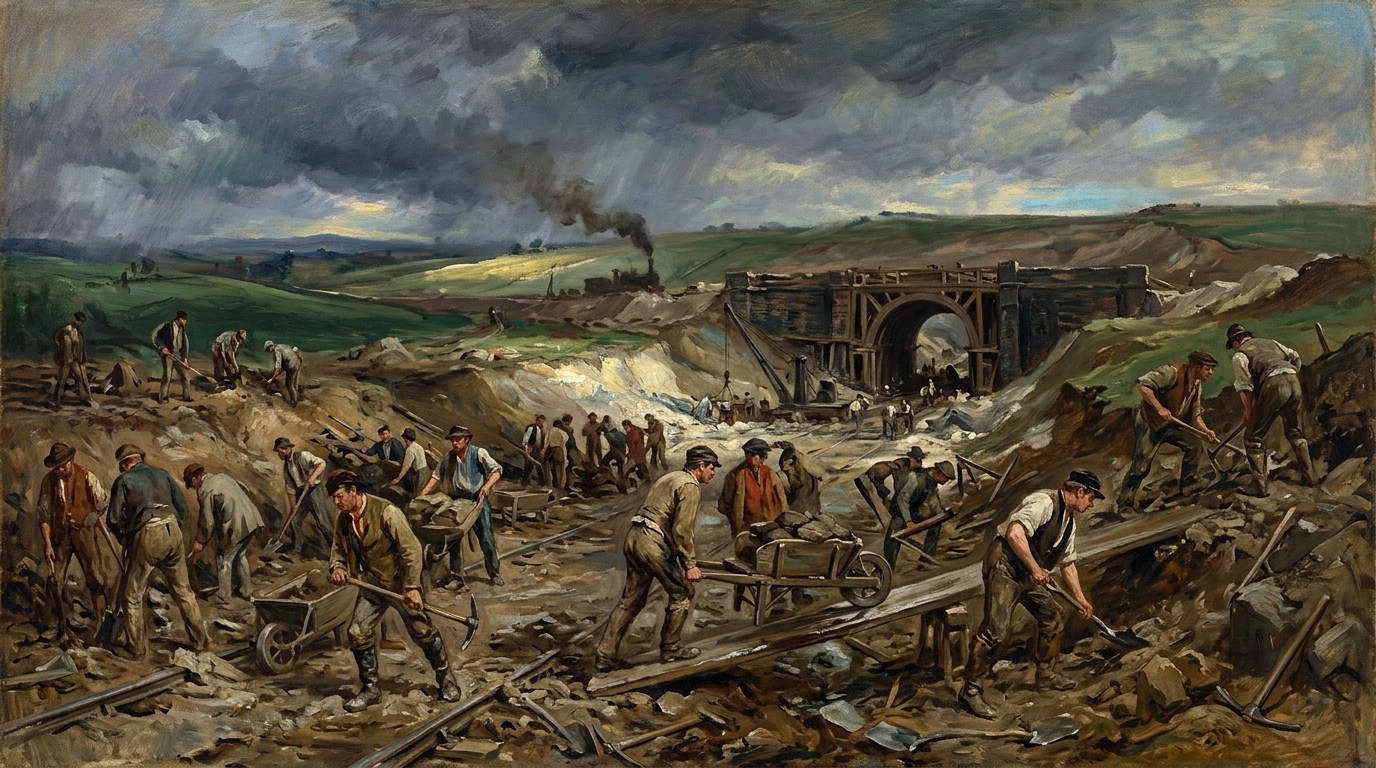
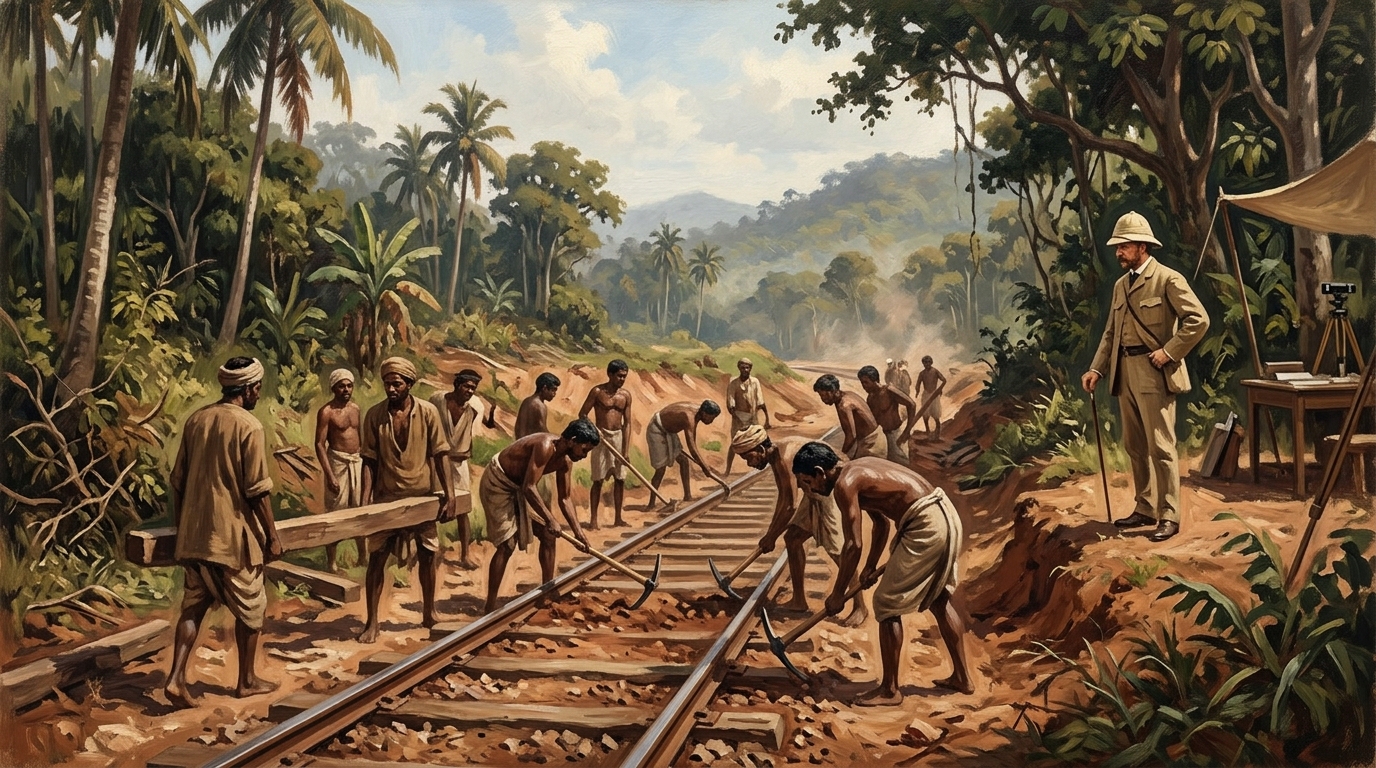
The workers who built those aristocratically negotiated lines enjoyed no such leverage. By 1850, more than 200,000 navvies -- a force larger than the British Army and Navy combined -- had laid 3,000 miles of track. The average cost was three deaths per mile.
At the Woodhead Tunnel, bored through the Pennines between 1839 and 1852, thirty-two workers were killed and 140 seriously injured from a workforce that rarely exceeded 1,500 at any given time. Edwin Chadwick calculated that this casualty rate exceeded that of the Battle of Waterloo. Workers lived in mortarless stone huts, fourteen or fifteen men per dwelling, through winters that swept the high moors. Cholera and typhus moved through the camps with the ease of weather.
The economic machinery of their exploitation had been custom-built. A navvy earned fifteen to twenty-four shillings a week -- more than double the seven shillings a Berkshire farmhand took home. But the truck system made those wages a fiction. Workers were paid not in cash but in tokens redeemable only at contractor-owned shops that charged "an inordinate price for every article." This system had been outlawed by the Truck Act of 1831. Parliament exempted railway construction from the Act. Edward Littleton, the statute's own author, admitted the carve-out: contractors building railways and canals needed to run shops for their workers, and he "could not resist the Appeal made to except their cases." One navvy's testimony distilled the racket to a sentence: "They give us great wages, but they take it all from us again." Payment came at intervals stretching to nine weeks, and requesting cash instead of tokens cost a penny-in-the-shilling deduction. Another navvy told the 1846 inquiry that workers would accept lower nominal wages if paid in regular cash -- because the tommy-shop markups consumed the difference and more.
"I would not recommend the loss of time for the sake of all the extra lives it would save."
-- Wellington Purdon, assistant engineer at Woodhead Tunnel, testifying to Parliament, 1846
Purdon was explaining why his tunnel used dangerous quick fuses instead of slower safety fuses. His calculus -- speed of construction measured against the lives of expendable men -- was not an aberration. It was the operational logic of an industry that Parliament itself shielded from its own labor protections.
The camps bred a different kind of violence, too. Irish navvies -- many of them famine refugees, 280,000 of whom entered Britain through Liverpool in 1846 alone -- were commonly paid less and segregated into all-Irish gangs. When tensions broke, the result resembled small-scale warfare. At Penrith in January 1846, English workers mounted a coordinated assault on an Irish settlement at Plumpton; one Irishman was already dead when Dennis Salmon, beaten with a pick handle, called out for mercy and heard his attacker reply: "Pitch into the bugger, he's life enough in him yet." At Gorebridge on the Edinburgh-Hawick line, Scottish navvies organized a counterattack, mustering at Newbattle paper mills and marching south to sack Irish encampments. The violence was not incidental to the railway. It was produced by the same economic logic: cheap, expendable labor drawn from the most desperate populations, housed without civic infrastructure, and paid through systems that bred resentment on every side.
The 1846 Select Committee on Railway Labourers heard testimony like Purdon's, documented the death rates and the ethnic violence, and recommended reforms: extend the Truck Act to railways, hold companies liable for deaths and injuries, require adequate housing and sanitation. The report was never debated in Parliament. Navvies remained without legal protection until 1887 -- four decades after the inquiry that proved they needed it.
The Railway Regulation Act of 1844, championed by Gladstone, promised democratized travel: one train per day on every line at no more than a penny per mile, in covered carriages with seats, at a minimum average speed of twelve miles per hour. The railway companies responded with a masterclass in malicious compliance. They scheduled parliamentary trains at the most inconvenient hours -- predawn departures, late-night arrivals -- and ran them at the legal minimum speed. Lloyd's Weekly Newspaper complained in 1852 that these trains were "as uncomfortable as the law will allow." The Earl of Malmesbury described a Dorchester service requiring four-hour winter waits in Southampton. Arthur Kinnaird observed approvingly in 1872 that the service would attract only those "who ought to do so, because the comforts would be very inferior."
Before the Act, third-class passengers had no carriages at all. They stood in open goods wagons, unprotected from weather, sparks, and locomotive pollution. Francis Coghlan's 1838 travel advice was grimly practical: "Always sit with your back towards the engine, against the boarded part of the waggon; by this plan you will avoid being chilled by the current of cold air." Thomas Wood, traveling in 1845, was blunter: "We were put into a truck worse and more exposed than cattle trucks... they were swimming with rain." It took dead bodies to win working-class passengers a roof. On December 24, 1841, at Sonning Cutting on the Great Western Railway, eight stonemasons riding in open wagons were crushed to death when their train struck a landslip and the goods wagons behind them telescoped forward. The disaster was the immediate catalyst for the 1844 Act's requirement that third-class carriages be enclosed.
The genuine breakthrough came not from legislation but from commercial arithmetic. In 1872, James Allport of the Midland Railway placed third-class carriages on every train; by 1875, he abolished second class entirely, giving third-class passengers upholstered seats and backrests for the first time. The business case was straightforward: 84 percent of Midland passengers already held third-class tickets. Treating them decently was not philanthropy -- it was capturing a mass market. The Midland's competitors eventually followed. Commercial logic achieved in three years what the penny-a-mile mandate had failed to deliver in three decades.
The railway's most permanent class legacy was spatial. Before the train, most people lived where they worked. The railway made it possible to separate home from labor for the first time, and the resulting geography was anything but egalitarian.
The process was sequential and precisely stratified. In the 1840s and 1850s, wealthy families established villa suburbs along early railway lines -- Edgware, Surbiton. By mid-century, the lower-middle classes followed as fares dropped, threatening what one historian called "exclusive villadom." After the Cheap Trains Act of 1883, which abolished passenger duty on penny-per-mile fares and mandated workmen's trains before 7 or 8 AM, working-class dormitory suburbs emerged on the urban periphery. By 1903, 801 workmen's trains ran daily into London, and 100 million workmen's tickets were issued annually.
The fare structure operated as a de facto zoning law. Where cheap early-morning trains ran, housing for the lowest-paid workers was built. Where trains were marginally more expensive, clerks and artisans settled. Full-fare commuter services produced solidly middle-class enclaves. The railway company's timetable did not merely enable suburbanization -- it determined, with almost mechanical precision, the class composition of every neighborhood within walking distance of a station. The Metropolitan Railway created what one scholar described as "a dissociation from work and a greater focus on the family and the home" -- the invention, in effect, of modern domestic life as a concept spatially distinct from the workplace.
The railway touched every class. But it touched them differently -- compensating aristocrats, killing navvies, humiliating the poor, and ultimately sorting the expanding city into gradients of respectability calibrated to the price of a ticket. That sorting had a spiritual dimension, too. For the same institution that encoded class into the architecture of its carriages was about to collide with the one institution that claimed all souls were equal before a higher authority.
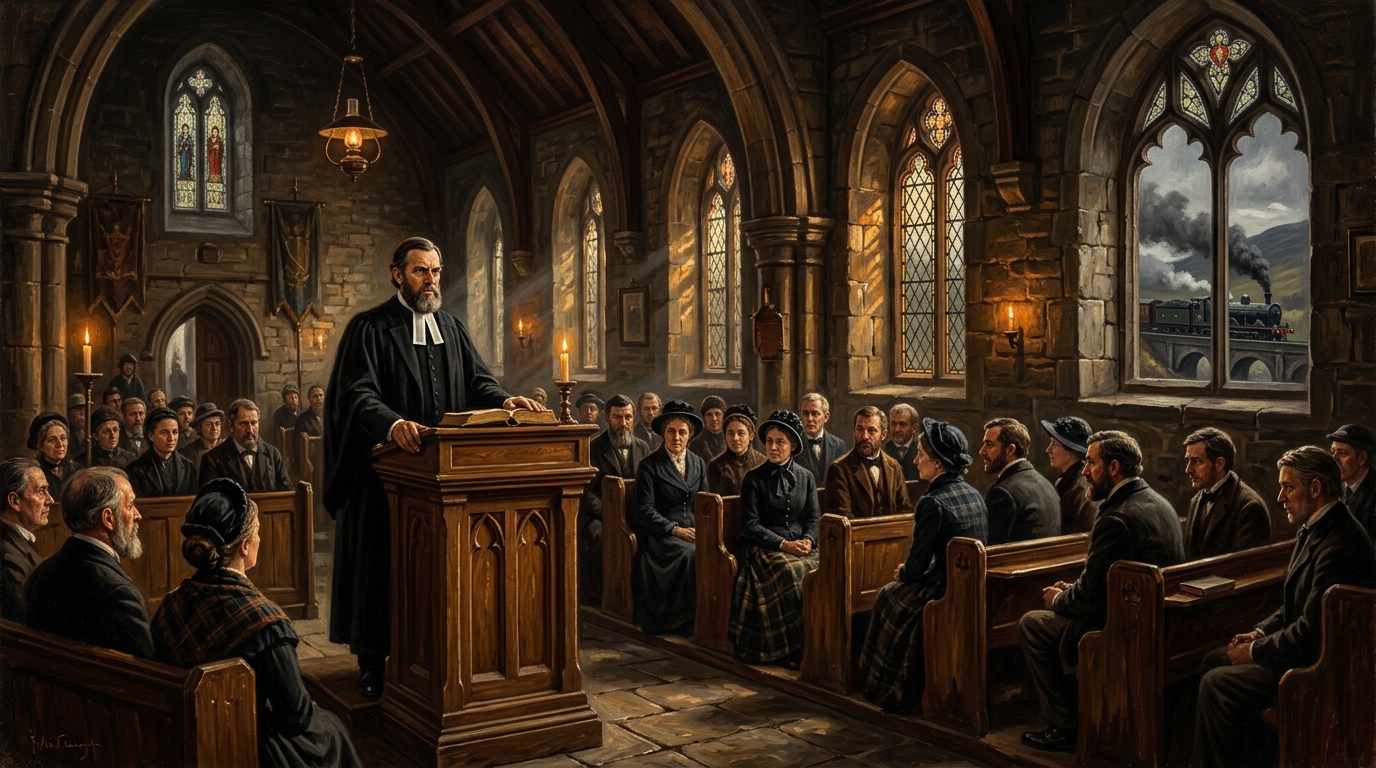
Between February 1842 and December 1846, the newly formed Free Church of Scotland forwarded 149 separate petitions against Sunday trains on the Edinburgh and Glasgow Railway -- more than the established Church of Scotland and all other denominations combined. The Free Church had existed for barely three years. It chose to announce itself to the world not through theological treatise but through a fight over a timetable.
The railway did not just rearrange the economy and unsettle the body. It invaded domains that Victorians considered sacred -- the Sabbath, the landscape, the moral order of wealth. And in each of those sacred spaces, the struggle over the iron horse produced institutions, movements, and financial instruments that endure centuries later. The National Trust, the modern insurance industry, the very concept of environmental activism -- all trace their origins to arguments about where a railway line should or should not go.
When the Edinburgh and Glasgow Railway opened on 21 February 1842, its directors offered what they considered a reasonable compromise: two Sunday trains in each direction, timed to avoid clashing with church services. The Scottish ecclesiastical establishment responded with a campaign of extraordinary institutional weight. Against a handful of town memorials supporting the Sunday timetable, opponents marshalled petitions from 41 towns, 134 kirk sessions, 40 presbyteries, 29 individual congregations, and 18 other church-connected bodies.
The timing was not accidental. The Disruption of 1843 -- the great schism that split the Church of Scotland -- fell right in the middle of this controversy. The newly formed Free Church seized on Sunday trains as a proving ground for its moral seriousness. In the two months after the railway directors agreed to reconsider, Free Church bodies forwarded those 149 petitions. The established Church managed 28. The message was clear: the Free Church would out-pious everyone, and the railway question was its instrument. The directors capitulated. Sunday passenger trains ceased after 15 December 1846. The practical fallout was quietly absurd -- the company introduced cheap Saturday-to-Monday return tickets and attached passenger carriages to the 3 a.m. Monday goods trains for workers desperate to get back.
John Stuart Mill recognized the deeper stakes. In On Liberty (1859), he singled out the "repeated attempts to stop railway travelling on Sundays" as a case study in religious zealots imposing their convictions on others through legal coercion. The Sabbatarian campaign was not principled rest advocacy -- it was social control with a sharp class edge. The Dean of Norwich's 1844 complaint made the subtext explicit: he worried not just about "profanation of the Sabbath" but that cheap fares tempted working-class passengers to sacrifice "Sunday dinner or some other item equally essential to their well-being," exposing them to "drinking and to excesses of even worse kinds." The concern was not merely that the Sabbath was broken. It was that the wrong sort of people were being given mobility on the wrong day.
The standard narrative emphasizes religious opposition, but a significant counter-current ran through every major denomination. Some clergy viewed the locomotive not as the devil's work but as evidence of divine providence -- and their interpretive frameworks split along theological lines with surprising coherence. Broad Churchmen read railways as signs of "enlightened progress." Evangelicals saw the new discipline of punctuality as embodying "the Protestant work ethic." Catholics perceived in the "shared wisdom and co-operation of engineers, locomotive crews, and signalmen" a reflection of "the mystery of a dedicated priesthood." Each denomination found in the railway a mirror for its own ecclesiology.
Bishop James Fraser of Manchester spent his weeks from 1870 to 1885 traveling by train through his vast diocese, enabling a ministry of confirmation and visitation that would have been physically impossible at horse speed. In America, the embrace went further still. The American Baptist Publication Society collaborated with wealthy industrialists in the 1890s to commission railroad chapel cars -- mobile churches on wheels that traveled from town to town, bringing services to communities too small to sustain a permanent pastor. The first, the Evangel, was dedicated on 23 May 1891. Missionaries could now "travel much faster than the traditional tent revivalists" -- the iron horse recast as a chariot of salvation.
The theological split reveals something fundamental about how religious institutions process technological change. The technology itself was neutral. The argument was about authority -- about who got to define the temporal order of the week, and whether a timetable printed in Edinburgh could overrule a commandment handed down from Sinai.
William Wordsworth's 1844 sonnet "On the Projected Kendal and Windermere Railway" is often treated as a literary monument to anti-industrial sentiment. The full story is more consequential -- it traces a direct line from a poet's anguish to the creation of one of Britain's most powerful institutions. And it shares a structural logic with the Sabbath wars that is rarely acknowledged.
Both movements defended a domain they considered sacred -- the Lord's Day, the Lake District -- from railway encroachment. Both framed their arguments in terms of higher values (divine commandment, natural beauty) while being animated in practice by anxieties about class and social order: the Dean of Norwich worried about the wrong sort traveling on Sundays; Ruskin would soon worry about the wrong sort picnicking at Grasmere. Both achieved partial success in the short term -- Sunday trains were cancelled in Scotland, the Windermere extension was halted -- and both were completely overrun within decades as railways became indispensable. Most remarkably, both produced institutional legacies that far outlived the specific controversies that spawned them: the Lord's Day Observance Society (founded 1831) and the National Trust (founded 1895). The parallel suggests that the Victorians' deepest resistance to railways was not technological but territorial -- a defense of spaces, temporal and physical, that the machine had no right to enter.
"Is then no nook of English ground secure / From rash assault?"
-- William Wordsworth, 1844
He followed with two letters to the Morning Post and two further sonnets at Furness Abbey, denouncing railway capitalists as "Profane Despoilers." Wordsworth failed -- the Kendal and Windermere Railway opened in April 1847, though it stopped at Windermere rather than pushing through to Ambleside. But his arguments planted seeds that bore fruit a generation later.
In 1875-1876, Robert Somervell, a Kendal shoe manufacturer, organized a campaign against further extension from Windermere to Ambleside, gathering between 3,000 and 4,000 petition signatures and publishing a pamphlet for which John Ruskin wrote the preface. Ruskin's contribution is a remarkable document. He dismissed claims of valuable mineral deposits along the route as "a wicked fiction" designed to deceive shareholders. He attacked the accessibility argument with vivid contempt, complaining that railways merely shuttled tourists between Keswick and Windermere, dumping visitors "like coals from a sack." And when defenders argued that railways would democratize access to natural beauty for the working class, Ruskin's response was bluntly elitist: workers could save their wages for "a day trip by chaise," and cheap transit would only create "taverns and skittle grounds round Grasmere."
The Somervell-Ruskin campaign succeeded -- no further extension was built. More importantly, their arguments influenced the creation of the National Trust in 1895. The modern conservation movement has roots in opposition to a specific railway. And it carries within it, often unacknowledged, the class anxieties that Ruskin articulated so candidly. The desire to preserve landscape was intertwined with a desire to control who had access to it.
While poets mourned and preachers thundered, the money poured in. At the peak of Railway Mania in 1847, railway investment consumed approximately 45 percent of total domestic capital investment -- a figure that would translate to over one trillion dollars in today's American economy. Railway stocks surged from 23 percent of London Stock Exchange value in 1838 to 71 percent by 1848. Parliament published a report in the summer of 1845 identifying twenty thousand individuals who had subscribed at least 2,000 pounds to railway stocks, including 157 members of Parliament and nearly 260 clergymen.
The investor base was remarkably democratic in its reach, if not its outcomes. Charlotte Bronte wrote that her sister Emily had "made herself mistress of the necessary degree of knowledge for conducting the matter, by dint of carefully reading every paragraph & every advertisement in the news-papers that related to rail-roads." Charles Darwin lost up to 60 percent of his investment. Middle-class families who had committed their entire savings were destroyed by the leverage trap -- shares could be purchased for as little as 5 percent down, but when prices collapsed, investors remained liable for the full unpaid balance. Railway shares fell approximately 66 percent from their 1845 peak to the April 1850 trough.
At the center of the wreckage stood George Hudson, the "Railway King," whose career prefigures every technology-era fraudster from Samuel Insull to Elizabeth Holmes. A York draper who inherited 30,000 pounds from a great-uncle, Hudson controlled railways accounting for a third of the entire British network by 1848. His technique was devastatingly simple: he consistently paid dividends of 10 percent -- not from profits, but from capital. In a market where consol yields sat at 3 percent and average railway dividends at 4.4 percent, Hudson's returns drew investment like a magnet. A shareholder committee eventually found he had embezzled between 600,000 and 750,000 pounds. He lost his parliamentary seat, fled to Paris, and was imprisoned for debt upon his return.
The standard reading is a textbook bubble story -- greed, fraud, collapse, ruin. Recent scholarship complicates this. Gareth Campbell of Queen's University Belfast assembled a dataset of 863 railway securities and found that, controlling for dividend changes, shares were "not obviously mispriced, even at market peak." The crash was driven less by irrational exuberance than by unforeseen shocks -- the Irish Famine, the 1847 Commercial Crisis -- that no investor could have reliably predicted. The Mania was simultaneously rational at the individual level and catastrophic at the systemic level, which is precisely the structure of every financial crisis since.
And the lasting infrastructure legacy inverts the usual moral of speculation stories. About a third of authorized railways were never built and share values were devastated -- but 90 percent of Britain's current railway system derives from routes laid during the mania era.
One of the least heralded but most consequential innovations born from railway disruption was personal accident insurance. Before railways, insurance covered property and life. The concept of insuring against bodily injury from a specific mode of transport did not exist because no mode of transport had previously posed such a novel, quantifiable risk to such a large paying public.
The Railway Passengers Assurance Company, established in 1849 with founding capital of 1,000,000 pounds, reached agreements with railway companies to sell insurance alongside travel tickets at station booking offices. First-class passengers paid threepence for 1,000 pounds of death coverage; second-class paid twopence for 500 pounds; third-class paid one penny for 200 pounds. The pricing was class-inverted in a revealing way -- the safest passengers paid the most while the most endangered third-class travelers in open-topped carriages received the least coverage. Between August 1849 and late February 1850, the company sold 65,353 single-journey tickets. Booking clerks received 10 percent commission, though railway management sometimes discouraged active promotion, fearing that discussing accidents would heighten passenger anxiety.
This was embedded distribution -- selling insurance at the point of purchase -- a model that insurtech companies in the 2020s market as a digital-age innovation. The Railway Passengers Assurance Company pioneered it 175 years earlier, at a booking window, for threepence. Its lineage runs directly through to modern Aviva.
The cultural response to railways was not confined to Wordsworth's study or Ruskin's drawing room. Kirstie Blair's 2022 research in the Journal of Victorian Culture uncovered a body of working-class poetry that upends the dominant narrative of worker alienation from industrial machinery. These were not abstract laments about "the Machine" -- they were intimate, personalized relationships with specific devices.
Workers wrote farewell poems to individual looms. They composed love poems to carding machines. Alexander Anderson's Songs of the Rail (1878) addressed engine-driving directly. Edwin Mead's "The Steam-King," published in the Chartist newspaper Northern Star in 1843, represented the "iron arm" of machinery as a figure of power. Most striking is William Lawson's "The Circular Saw" (1869), written after a severe hand injury -- a poem in which the machine is given its own reply, its own defense.
This body of work exposes a gap in perception that is arguably the central cultural fault line of industrialization. The middle-class observer saw "the Machine" as an abstract, dehumanizing force. The worker who spent twelve hours a day with a specific engine knew its moods, its quirks, its dangers -- and mourned it when it was replaced. The relationship was intimate, particular, and often affectionate, even when it cost a hand.
The sacred and the speculative, the poet and the penny-insurance clerk, the kirk session and the stock exchange -- all grappled with the same iron intrusion into their worlds. Some built institutions that endure. Others built fortunes that collapsed. But none of them could stop the timetable from rewriting daily life. By the time the Sabbatarians won their battle against Sunday trains in Scotland, milk was arriving in London by rail. By the time Ruskin's conservation campaign stopped the Windermere extension, newspapers depended on railway distribution to reach readers the same morning. The railway was not winning arguments. It was making itself indispensable -- and that turned out to be a far more effective strategy than persuasion.
Henry David Thoreau"We do not ride on the railroad; it rides upon us."
By 1870, British railways carried 423 million passenger journeys a year. Forty years earlier, the technology had killed a former cabinet minister at its public debut. The gap between those two facts -- between the Huskisson death and a nation restructuring its daily life around train timetables -- represents one of the fastest mass behavioral shifts in recorded history. This was not a generational change. The people who witnessed the Liverpool and Manchester opening in 1830 lived to see their grandchildren commute by rail. Many of them commuted by rail themselves.
The compression of this timeline defies the standard model of technology adoption, which assumes a slow diffusion through early adopters, mainstream users, and late holdouts. The railway skipped the slow part. The 1844 Railway Regulation Act forced every company to run at least one daily train stopping at every station, at a penny per mile, with third-class passengers seated and sheltered -- conditions that sound modest until you consider that third-class travel previously meant standing in open goods wagons attached to freight trains, exposed to weather and cinders. Within five years of the Act, over half of all railway revenue came from the cheapest tickets. Demand had never been the problem. Survival had been the problem.
Then came the event that turned millions of individual decisions into an irreversible cultural fact. The Great Exhibition of 1851 drew six million visitors to the Crystal Palace -- fully a third of Britain's population. The overwhelming majority arrived by train. Thomas Cook alone arranged transport for 150,000 visitors and sold 165,000 excursion tickets. Factory workers traveled in organized groups, many boarding a train for the first time. Six million people completed a railway journey without incident, then went home and told their neighbors about it. No safety pamphlet, no medical reassurance, no government endorsement could match the persuasive power of that mass experience.
Thomas Cook's role in normalization deserves a closer look, because his origin story inverts every assumption about how commercial industries begin. Cook was not an entrepreneur. He was a Baptist temperance activist who had walked over 3,000 kilometers across England promoting sobriety before it occurred to him that railways could serve his cause more efficiently than his feet.
His first excursion, on July 5, 1841, transported 485 members of the Leicester Temperance Society from Leicester to Loughborough at one shilling each. The trip was designed to keep people away from pubs, not to create an industry. But the model -- chartering a train, negotiating a group rate, providing an organized itinerary -- proved so compelling that Cook began applying it to secular purposes. By 1845, he had organized his first true package tour: Leicester to Liverpool for one guinea, including rail transport, meals, and a printed handbook. That handbook matters. It transformed the railway journey from an anxiety-riddled negotiation of unknown schedules into a guided, comprehensible experience. Cook's background as a printer made him instinctively understand that information tames fear.
The seaside excursion became the primary vector of working-class normalization. The first day-trip from London to Brighton in 1844 attracted crowds described as unlike anything previously seen, with return tickets at three shillings and sixpence. The Bank Holidays Act of 1871 accelerated the transformation by granting working-class families both the time and social permission to travel for pleasure. Blackpool, barely a settlement before the railway, became Britain's premier working-class resort -- its entire economy dependent on excursion traffic for the next 150 years. The seaside holiday, a concept with no working-class precedent before railways, became so deeply embedded in British culture that it retroactively made the railway seem not just safe but essential.
Railway companies spent remarkably little effort on what we would now call public relations to address fears about safety. They pursued a more effective strategy: making the journey itself desirable.
The Midland Railway's 1875 abolition of second class stands as the single most consequential comfort innovation of the century, and its logic was commercial, not humanitarian. By that year, 84 percent of Midland passengers already traveled third class. Rather than maintain a degraded middle tier, the company scrapped the old third-class coaches, redesignated second-class coaches as the new third class, and cut first-class fares to former second-class levels. The effect was immediate: for the first time, every passenger sat on upholstered seats with backrests, in enclosed, weatherproofed compartments. Competitors, bleeding passengers to Midland trains, were forced to follow suit. What three decades of parliamentary legislation had failed to achieve -- dignified travel for ordinary people -- commercial competition delivered in a single stroke.
The physical transformation of the experience extended far beyond seating. Early Victorian trains confined passengers to sealed compartments for the entire journey -- no corridor, no lavatory, no way to summon help. By the 1890s, corridor-connected carriages with lavatories were standard on prestige services. Electric lighting arrived in 1894, replacing dim gas lamps. Dining cars offered what contemporaries described as "sophisticated food on the move," and the Midland's new third-class dining cars were reportedly comparable to first class on rival lines. A third-class journey in 1895 bore almost no resemblance to the freezing, open-wagon ordeal of the 1830s. The railway had not persuaded the public that travel was safe. It had made travel pleasant enough that the question stopped mattering.
The most powerful normalization mechanism was none of the above. It was infrastructure embedding -- the quiet process by which railways became the substrate of daily life itself.
The Travelling Post Office arrived in 1838, two years before Rowland Hill's Penny Post even took effect. When that reform launched in 1840, halving letter costs to one penny regardless of distance, mail volume more than doubled in a year. The explosion in correspondence was only physically possible because railways could move that volume at speed. The railway did not just carry existing mail faster; it created a communication revolution.
Food followed the same pattern. The Great Western Railway launched a daily milk train in 1860. Before rail transport, London's milk came from diseased cows kept in urban cellars under notoriously unsanitary conditions. By 1890, 84 percent of London's liquid milk arrived by rail from the West Country and the Midlands -- a transformation in public health that receives surprisingly little historical attention. Fish-and-chips, dependent on rapid distribution of fresh fish from ports like Grimsby, became a national dish rather than a coastal specialty for the same reason.
WHSmith opened its first railway bookstall at Euston in 1848 and expanded to 1,240 station bookstalls by 1902, selling same-day newspapers, cheap "yellowback" novels designed for train reading, and portable reading lamps for unlit carriages. The yellowback novel deserves recognition as something more than entertainment. Reading on trains was not a natural behavior -- it had to be invented and provisioned. Early passengers found the speed of the passing landscape disorienting, even nauseating. A book offered an alternative focus, a way to fill the journey without confronting the unsettling blur outside the window. The yellowback was, in a very real sense, a coping mechanism that became a cultural institution.
And then there was time itself. The dual-handed clocks of Oxford and Bristol -- the institutional defiance of communities that refused to let a railway timetable overrule the position of the sun -- told only the opening chapter of that story. The resistance, however principled, was futile. By 1855, roughly 98 percent of British towns had adopted Greenwich Mean Time, though Parliament did not ratify the change until the Statutes (Definition of Time) Act of 1880. The railway's telegraph signal, carried along its own tracks, set the clocks that governed civic life. When your sense of what time it was depended on the railway's infrastructure, the railway had ceased to be a technology you used. It had become the framework through which you experienced reality.
The strangest chapter in normalization is the decade when it should have faltered. The 1860s saw peak railway dependence and peak disaster publicity simultaneously. The Staplehurst crash of June 9, 1865, killed ten people when a boat train derailed over a maintenance gap. Its most famous survivor, Charles Dickens, spent the remaining five years of his life battling what he called "sudden vague rushes of terror, even when riding in a hansom cab, which are perfectly unreasonable but quite insurmountable." His children watched him grip carriage armrests in white-knuckled panic, perspiration covering his face.
Dickens's trauma did not reduce public ridership. The numbers kept climbing. The pattern is instructive: by the 1860s, practical dependency on railways ran too deep for even spectacular disasters to reverse. People did not stop traveling. They demanded that travel be made safer. The communication cord, first proposed in 1866 and made compulsory by the Railways Regulation Act of 1868, channeled fear into reform rather than rejection. The railway had passed the point where society could choose to refuse it. The only remaining question was on whose terms it would operate.
That question -- who controls a technology that has become indispensable -- was not unique to Britain. Across Europe, across the Atlantic, and deep into colonized territories, societies were asking the same thing in very different ways.
Helmuth von Moltke, 1843"Every new railway development is a military benefit, and for national defense it is far more profitable to spend a few million on completing our railways than on new fortresses."
In 1842, Baptiste Alexis Victor Legrand unrolled a map of France and drew five lines. Every one of them converged on Paris. The Legrand Star -- Paris to Lille, Paris to Strasbourg, Paris to Le Havre, Paris to Lyon-Marseille, Paris to Bordeaux -- was not designed to move freight efficiently or serve the densest population corridors. It was designed to reinforce the political supremacy of the capital. Republican theorists had insisted that private groups directing the economy threatened the sovereignty of the central state, and so the railway became an act of state architecture: the government built the roadbed, private companies laid the rails, and the resulting geography embedded a political philosophy into iron and gravel. To this day, it remains easier to travel from any French city to Paris than from one provincial city to another. An 1842 decision still governs the daily commute.
France's deliberate approach carried a cost. By the time Legrand drew his star, Britain already had 1,900 miles of operational track. France had 300. Centralized planning traded speed for control -- and the trade-off would prove fateful.
If France used railways to reinforce an existing center of power, the German states used them to create one. In the 1830s, "Germany" was a patchwork of thirty-six sovereign entities, each jealous of its independence. Friedrich List, an economist imprisoned for his political agitation who had observed American railways during exile, saw what few others did: railways would create the material conditions for a unified German market, and a unified market would demand political unification. The Leipzig-Dresden line, established in 1839 as Germany's first long-distance railway, followed his organizational model.
The military possibilities were not lost on a young Prussian officer named Helmuth von Moltke. "Every new railway development is a military benefit," he wrote in 1843, "and for national defense it is far more profitable to spend a few million on completing our railways than on new fortresses." By 1860, as chief of the general staff, Moltke reportedly never made major decisions without consulting German railway timetables. During the 1866 war against Austria, he moved nearly 200,000 troops and 55,000 horses to the Bohemian border by rail, their deployment forming a 200-mile arc that became his famous strategy of external lines.
The Franco-Prussian War of 1870 delivered the sharpest lesson. Prussia moved approximately 500,000 men to concentration areas in eleven days, coordinated through a central committee overseeing nine railway lines. The surprise: neutral observers at the time considered the French railway system superior. France moved 300,000 troops in three weeks with only two accidents -- respectable by any standard. But the Vth Corps was shuttled back and forth by contradictory orders, first to Nancy, then toward Langres, then Toul, then finally Chalons. France had the tracks. Germany had the timetable. The war was won not by better infrastructure but by better organization -- a distinction that challenges the assumption that the most advanced technology always wins.
No country invested railways with more mythological significance than the United States. The locomotive was the "iron horse," the transcontinental railroad was manifest destiny wrought in iron, and the golden spike at Promontory Summit in 1869 was framed as the completion of national prophecy. Within a decade, the transcontinental line shipped $50 million worth of freight annually; books written in San Francisco found homes on New York shelves a week after publication.
The cost of that prophecy was borne by those who already occupied the land. The railroad was, as one historian put it, "an irrevocable marker of encroaching white society." Millions of buffalo fell to indiscriminate slaughter, their hides shipped east along the rails, decimating the resource base of the Plains nations. Tribes were forced onto reservations within decades. The railroad did not merely change the American landscape -- it emptied it of its prior inhabitants.
The Civil War exposed a different asymmetry. The Union controlled roughly 21,000 miles of track to the Confederacy's 9,000, but the disparity ran deeper: the South held one-third of the North's freight cars, one-fifth of its locomotives, and one twenty-fourth of its locomotive production capacity. Confederate railways had been built for short hauls of cotton to nearby ports, not lateral movement of armies. Different gauges meant Confederate troops sometimes required eight transfers during a single deployment. When Longstreet's 13,000 men needed sixteen days to travel 950 miles with multiple gauge-related transfers, the Union mobilized 22,000 soldiers over twelve hundred miles in eleven.
"We do not ride on the railroad; it rides upon us. Did you ever think what those sleepers are that underlie the railroad? Each one is a man."
-- Henry David Thoreau, Walden
Thoreau's wordplay collapsed the distinction between the wooden ties -- called "sleepers" -- and the human bodies sacrificed to lay them. He was, as scholars have noted, a minority voice. But the minority had the sharper eye.
Colonial railways belong to a fundamentally different category. In Britain, France, Germany, and even America, railways emerged from within -- driven by domestic capital, domestic political will, and domestic demand, however contested. In India, Kenya, and the Congo, railways were imposed from without, designed to serve the colonizer, and financed through mechanisms that transferred costs to colonized populations while directing profits to European investors.
Lord Dalhousie initiated Indian railway construction in 1853. The 1857 Rebellion transformed the program's character: stations became fortresses, staff became an auxiliary army, and tracks became lines of military communication across a territory whose population had just demonstrated its capacity for coordinated revolt. The financing revealed the extractive logic. The Bengal-Nagpur line was built with Rothschild capital, but British authorities mandated that guaranteed profits be funded by an extra tax on local peasants. The railway's costs were socialized onto Indian agriculturalists; its returns flowed to London.
The experience inside the carriages distilled the colonial hierarchy. While Europeans traveled in first-class luxury, Indian third-class passengers -- the vast majority -- were crammed into squalid conditions, fighting even for the right to toilets on trains. Gandhi, thrown from a first-class carriage in Pietermaritzburg, made this indignity the centerpiece of a political strategy. He traveled third-class despite his relative wealth, and his 1917 pamphlet Third Class in Indian Railways turned the railway carriage into a symbol of colonial injustice.
In Kenya, 30,000 Indian laborers recruited from Punjab and Gujarat built the Kenya-Uganda Railway between 1896 and 1901. Approximately 2,500 died from disease, accidents, and animal attacks. The Nandi people mounted an eleven-year guerrilla resistance led by Koitalel Arap Samoei, raiding equipment depots and killing railway workers until Samoei was murdered during supposed truce negotiations -- his body decapitated. In the Congo, the official death toll for the Matadi-Leopoldville railway was 1,932 workers, but the real numbers were far higher. In 1892 alone, roughly 150 workers died per month. Workers recruited from Barbados reportedly refused to leave their boats at Matadi until forced off at gunpoint.
Yet here lies the deepest paradox. The tool of oppression became the instrument of liberation. Indian railways bound the subcontinent together in ways that enabled nationalist organizing on an unprecedented scale. During the Non-Cooperation Movement, the Salt March, and Quit India, railways carried organizers, pamphlets, and political consciousness across the country. Ticketless third-class passengers pulled alarm chains to disrupt services during the Civil Disobedience Movement. "The invention that did most to keep the Indians in check proved to be double-edged," one historian wrote, "stimulating the nationalistic forces which eventually triumphed." Bismarck and Gandhi occupied opposite ends of the political spectrum and opposite ends of the century, but both understood the same thing: whoever controlled the railway network controlled the political geography.
Not every encounter followed the colonial script. Japan opened its first railway in 1872 -- not under compulsion but as a deliberate act of sovereign modernization. Foreign engineers were contracted with the explicit understanding that they would train Japanese counterparts; Japan achieved technological self-sufficiency within a generation. Siam, never colonized, built railways specifically to deter British and French territorial ambitions, reasoning that modern infrastructure would present the kingdom as too civilized to justify conquest. Where sovereignty existed, societies could adopt railway technology on their own terms.
The same technology, arriving in different societies, produced radically different outcomes -- centralized control in France, national unification in Germany, continental conquest in America, extraction and resistance across the colonized world, sovereign modernization in Japan. A 2023 study in the American Political Science Review found that railways, while enabling state centralization, paradoxically increased the risk of separatist mobilization when they first reached ethnic minority regions -- the integrating technology was simultaneously a separating one. The differences reveal that what matters is never the technology itself but the structures of power it enters: who finances it, who builds it, who rides it, who benefits, and who bears the cost.
Institutional fear giving way to grudging dependence. The gap between those who build the infrastructure and those who profit from it. Class-differentiated access encoded into the design. Normalization that comes not from persuasion but from making the new system load-bearing before anyone votes on it. The question of who the technology serves answered not by the technology's inventors, but by the structures of power already in place when it arrives.
These patterns did not retire with the steam engine. They are structural, not historical. And the reader who has followed the railway's story this far already knows where else they apply.